
Tabea Kind – Dialogue Poetry
Release: 20. November 2026
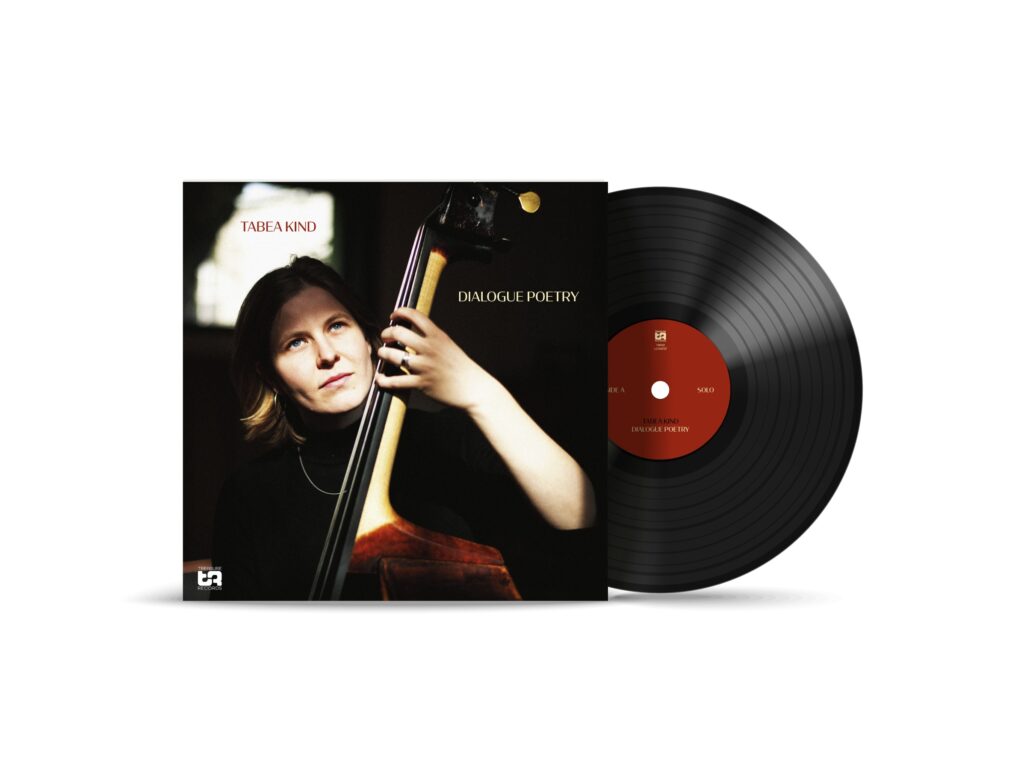
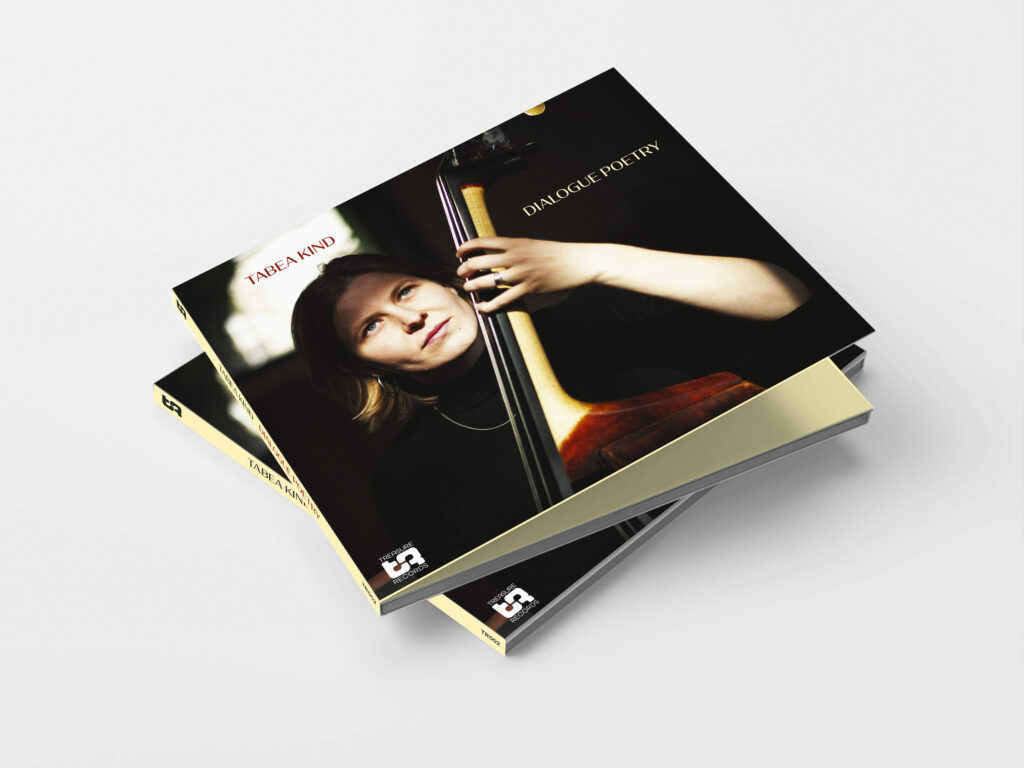
Dialogue Poetry
1. Falls (Solo Version) 2:51
2. Life as an artistic technique (Solo Version) 2:10
3. Dialogue Poetry (Solo Version) 2:02
4. Earli (Solo Version) 3:29
5. Dramelo (Solo Version) 2:04
6. Turning (Solo Version) 1:59
7. Yes, but only in the abstract (Solo Version) 2:19
8. Falls 4:29
9. Life as an artistic technique 4:16
10. Dialogue Poetry 4:55
11. Earli 5:19
12. Dramelo 3:20
Total Time: 39:13
Line-Up
Tabea Kind – piano (track 1-7), voice (track 1,4), bass (track 8-12)
Lucas Leidinger – piano (track 8-12)
Lucas Zibulski – drums (track 8-12)
Recorded Januar 11 2026 at O-Ton Studio by Andreas Hanten.
All songs written by Tabea Kind.
Produced by Tabea Kind & Rebecca Trescher.
Liner Notes
Tabea Kind ist eine der Musikerinnen, der wir ob ihrer immensen Musikalität oft alles Mögliche zutrauen. So ist es nicht verwunderlich, wenn die in Köln lebende Kontrabassistin sich entscheidet, auf ihrem zweiten Album nicht nur alle Stücke zu komponieren und im Triokontext Bass zu spielen, sondern auch eine erste Plattenhälfte zu präsentieren, auf der sie alle Stücke als Solofassungen am Klavier spielt und singt. Wir hören die Stücke so, wie Kind sie in den Abendstunden in der Wohnung in Köln geschrieben hat. Und später auf dem Album hören wir ebendiese Stücke auch im Triokontext. Aufgenommen im O-Ton Studio in der Kölner Südstadt, dürfen wir jetzt an Dialogue Poetry teilhaben:
Wir hören also zunächst die Essenz dessen, was später Ensemblestücke werden: die Melodien solo am Klavier, teilweise mit Stimme. Einerseits ist das eine willkommene und eher unübliche Einladung hinter die Kulissen des perfektionierten – und dabei nicht minder spannenden – Ensemblespiels, das uns in der zweiten Albumhälfte erwartet.
Andererseits ist es der starke Ausdruck des Zugeständnisses der eigenen Zerbrechlichkeit; ist es die Offenheit, die Geschichte in den Vordergrund treten zu lassen und die Virtuosität zumindest hintenanzustellen. Immer klare, obwohl teils schwindelerregende Melodien finden uns bereits in den Solostücken, im Folgenden dann ausgemalt, gedehnt und wunderschön umgedeutet von Kind am Bass mit Lucas Leidinger am Flügel und Lucas Zibulski am Schlagzeug. Besonders spannend ist neben der allgemeinen Spielfreude des Trios der Zwischenraum, der sich zwischen Solo- und Trioversionen aufspannt:
Falls, der Fall des Falls, eröffnet das Album. Ist andächtig, teils kantig im Solo, beschwingter im Trio. Life as an artistic technique lädt uns ein, die kleinen Künste und Improvisationen des Lebens voll auszuschöpfen. Laden die Rubatopassagen etwa dazu ein, mal mit bewusst wechselndem Schritttempo morgens die Brötchen holen zu gehen? Dann ist da der ewige Atem des Stückes Earlie, ein Geschenk an eine Freundin, die viel zu früh gestorben ist. Und auf Dramelo spielt sich erst Tabea Kind allein, und dann das gesamte Trio in den Rausch. Das tanzende Titelstück Dialogue Poetry ist den gemeinsamen Gesprächen mit der Schwester gewidmet.
Und auch das Album als Gesamtes lässt sich als offener Dialog verstehen: wir dürfen Kinds ganz eigene Interpretation ihrer Stücke hören, und die Antwort des Ensembles. Das Ergebnis sind zwölf Stücke und Stückversionen, die durch Klarheit bestechen, mal durch Virtuosität, mal durch den Raum zwischen den Tönen, mal durch genau das Vibrato, das Kinds Stimme am Ende des Tons erwischt. Wir hören den Vortrag (Solo) und die Diskussion (Trio), die zusammen das Gedicht aufspannen. Mit Platz in der Mitte für uns Hörende.
Dialogue Poetry. In jedem Fall leben wir das Leben. Mit Kunst. Zusammen, mit denen die sind und mit denen, die immer vermisst werden. Mit Freude und mit Dramatik, im einzigen Rausch. Sollten wir vielleicht alles umdrehen, suchen, auf den Kopf stellen? Yes, but only in the abstract.
– Sonia Loenne
Liner Notes
Tabea Kind is one of those musicians whose immense musicality often leads us to believe she is quite capable of just about anything. So, it comes as no surprise that the Cologne-based double bassist has decided not only to compose all the tracks and play bass in a trio setting on her second album, but also to present the first half of the record solo, playing the piano and singing. We hear the pieces just as Kind penned them in the evenings in her flat in Cologne. Later, we hear these very same pieces performed in a trio line-up. Recorded at the O-Ton Studio in Cologne’s Südstadt district, we can now experience Dialogue Poetry:
Initially, we hear the essence of what will later become ensemble pieces: the melodies played solo on the piano, sometimes accompanied by Kind’s voice. On the one hand, this is a welcome and rather unusual invitation behind the scenes of the perfected – and no less exciting – ensemble work that awaits us in the second half of the album.
On the other hand, it is a powerful expression of the recognition of the artist’s own fragility; it is the openness to let the story take centre stage and to subordinate the virtuosity, at least for the time being. Clear, albeit at times dizzying melodies are already present in the solo pieces, and are subsequently elaborated upon, extended and beautifully reinterpreted by Kind on bass, with Lucas Leidinger on the grand piano and Lucas Zibulski on drums. Alongside the trio’s infectious enthusiasm, it is the space that spans the solo and trio versions that is particularly fascinating:
Falls, German for ‘in case’, opens the album. It is contemplative, at times edgy in the solo version, livelier in trio. Life as an artistic technique invites us to make the most of life’s little artistry and improvisations. Do the rubato passages, for instance, invite us to go and fetch our morning paper at a deliberately varying pace? Then there is the eternal breath of the piece Earlie, a gift to a friend who passed away far too soon. And on Dramelo, Tabea Kind first dizzies herself into trance, before the whole trio gets carried away. The playful title track Dialogue Poetry is dedicated to conversations shared with her sister.
The album as a whole can also be understood as an open dialogue: we are treated to Kind’s very own interpretation of her pieces, and the ensemble’s response. This results in twelve pieces and interpretations that captivate through their clarity, at times through their virtuosity, at times through the space between the notes, or the precise vibrato that catches Kind’s voice at the end of a note. We hear the recital (solo) and the discussion (trio), which together unfold the poem. Leaving room between them for us, the listeners.
Dialogue Poetry. In any case, we live life. With art. Together, with those who are here and with those who are always missed. With joy and intensity, in a whirlwind. Should we perhaps turn everything upside down, search, turn it on its head? Yes, but only in the abstract.
– Sonia Loenne